
The year 2026 marks a watershed moment in the evolution of technology. We have officially moved past the “AI hype” cycle and entered the era of AI-Driven Intelligence & Automation. For years, automation was synonymous with “doing”—executing repetitive, rule-based tasks with speed. Today, the focus has shifted to “thinking”—the ability of systems to perceive, reason, and act autonomously within complex environments.
In this post, we explore how AI-driven intelligence is rewriting the rules of business, the rise of agentic systems, and what this means for the future of work.
1. From “If-Then” to Agentic AI
Traditional automation relied on rigid “if-then” logic. If a customer sends an email with the word “refund,” then forward it to the billing department. While efficient, these systems were fragile; a slight deviation in language or a complex request would break the process.
In 2026, the standard has shifted to Agentic AI. Unlike its predecessors, an AI agent doesn’t just follow a script; it understands a goal. If you tell an agent to “onboard a new vendor,” it doesn’t wait for a 50-step manual. It autonomously identifies the required documents, reaches out to the vendor, performs a background risk assessment using real-time data, and populates the ERP system—notifying a human only when a subjective judgment is required.
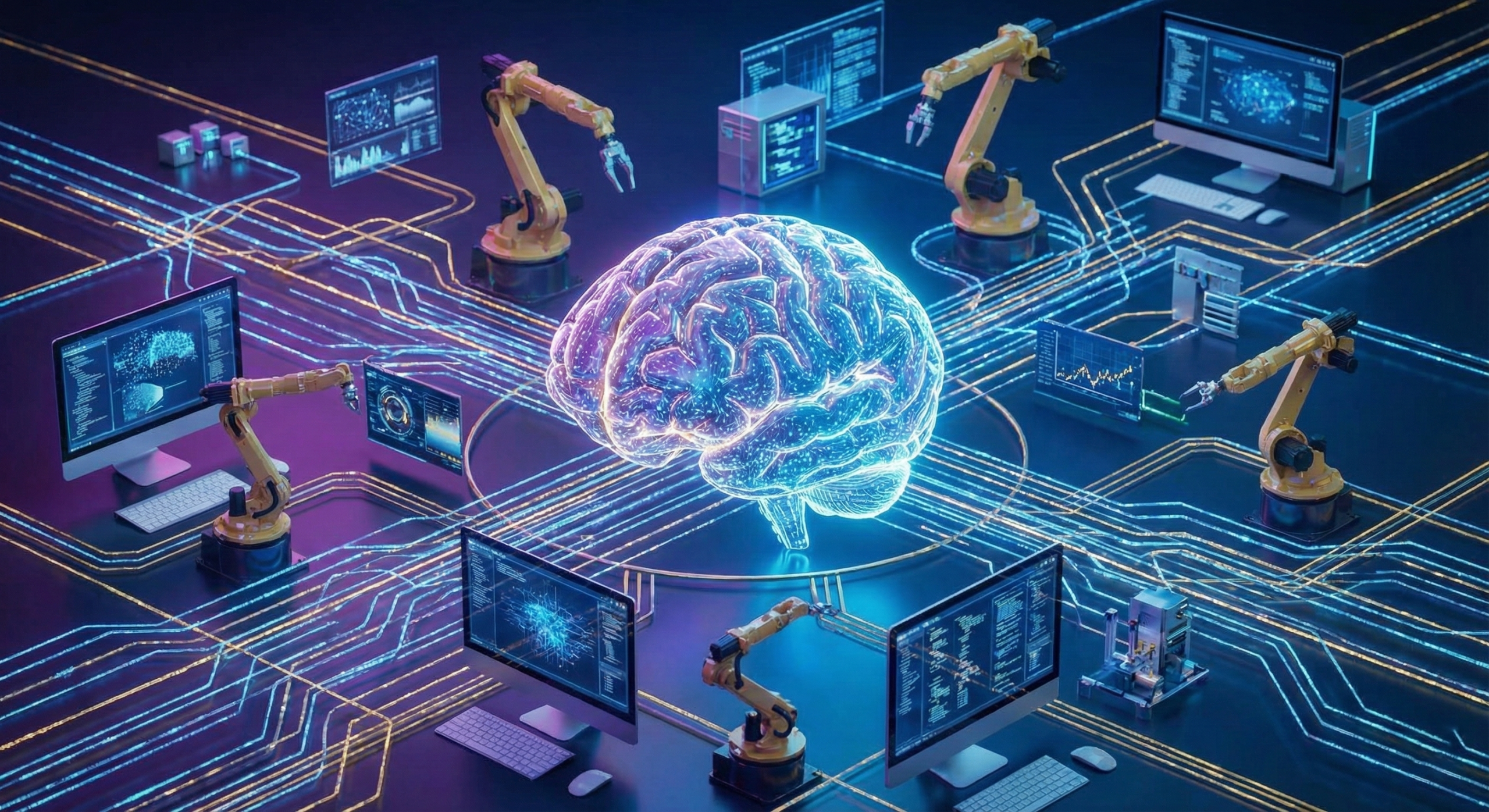
The image below illustrates this concept, with a central AI “brain” coordinating a network of robotic arms and data streams, symbolizing the shift from simple automation to intelligent, autonomous orchestration.
Key Characteristics of Agentic Systems:
-
Self-Correction: If a tool fails or a piece of data is missing, the agent finds an alternative path rather than throwing an error.
-
Context Awareness: These systems “remember” past interactions and current business goals to make more nuanced decisions.
-
Multi-Step Planning: They can break down high-level objectives into smaller, actionable tasks and execute them in the correct sequence.
2. Hyperautomation: The Intelligent Fabric
While agentic AI provides the “brain,” Hyperautomation provides the nervous system. Organizations are no longer looking for isolated tools to fix specific problems. Instead, they are building end-to-end automated ecosystems that integrate AI, Machine Learning (ML), Robotic Process Automation (RPA), and Process Mining.
In this landscape, Decision Intelligence is the crown jewel. By 2026, AI-driven automation doesn’t just execute the back-office work; it assists in the boardroom. By analyzing millions of data points across supply chains, market trends, and internal performance, these systems can suggest the best time to launch a product or pivot a strategy with higher accuracy than traditional human-led analysis.
3. Industry Transformations in 2026
The impact of AI-driven intelligence is not uniform; it is deep and industry-specific.
Manufacturing: The Software-Defined Factory
Manufacturing has moved beyond simple robotic arms. Today, we see Physical AI. Sensors across a factory floor feed real-time data into a “Digital Twin.” If the AI detects a microscopic vibration in a turbine that suggests a failure in three days, it autonomously schedules maintenance, orders the part, and adjusts the production schedule to minimize downtime.
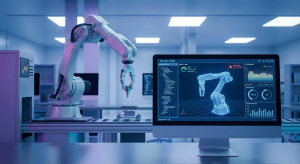
This is perfectly depicted in the following image, where a robotic arm on a factory floor is mirrored by a real-time digital twin on a screen, enabling predictive analytics and control.
Finance: Autonomous Fraud & Risk
In the financial sector, AI-driven automation has moved from reactive to proactive. Autonomous fraud detection systems now operate with “millisecond latency,” identifying and blocking suspicious transactions before they are even processed. Furthermore, AI-driven credit scoring models now include non-traditional data (like supply chain health for businesses), allowing for more inclusive and accurate lending.
Healthcare: Predictive Diagnostics
In 2026, AI isn’t replacing doctors; it’s providing them with a “super-intelligence” layer. Automated systems monitor patient vitals in real-time, using predictive analytics to alert staff to potential issues like sepsis hours before symptoms manifest. This is automation at its most vital—saving lives by removing the delay between data collection and action.
4. The Human Factor: Collaborative Automation
One of the most persistent fears of the AI era is job displacement. While it is true that routine roles—such as basic data entry, simple customer service, and manual bookkeeping—are being heavily automated, a new paradigm has emerged: Human-AI Collaboration.
The goal of modern automation is to “return time.” By handling the 80% of work that is procedural and administrative, AI allows humans to focus on the 20% that requires:
-
Empathy: Handling sensitive customer disputes or complex healthcare decisions.
-
Strategy: Thinking about where the business should go in the next five years.
-
Creativity: Designing the “next big thing” that data alone cannot predict.
Studies in 2026 show that teams using AI-driven automation effectively see a productivity boost of up to 40%, but more importantly, they report higher job satisfaction as the “drudgery” of work is removed.
This collaborative future is captured in the image below, showing a person engaged in creative, strategic work on a tablet, with a large AI-powered screen providing data-driven insights and suggestions.

5. Navigating the Ethical Frontier
With great power comes the need for robust governance. As we rely more on AI to make decisions, the “Black Box” problem becomes a significant risk. If an automated system denies a loan or filters a job application, we must be able to ask why.
Critical Ethical Pillars for 2026:
-
Explainability: AI models must be transparent enough for humans to audit their reasoning paths.
-
Bias Mitigation: Since AI learns from historical data, it can inadvertently learn historical prejudices. Continuous auditing and diverse training sets are now a legal and ethical requirement in many jurisdictions.
-
Data Sovereignty: As AI agents move data across borders and systems, maintaining privacy and adhering to regulations like the EU AI Act is more complex than ever.
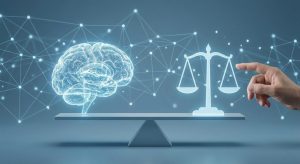
The image below provides a visual metaphor for this challenge, showing an AI “brain” on a balance scale with the concept of justice, symbolizing the need for ethical oversight and fairness in AI-driven decisions.
6. Conclusion: The Competitive Edge
In 2026, AI-driven intelligence and automation are no longer optional. The companies that are winning are those that have moved beyond “bolting on” AI to existing processes and have instead embraced AI-native architectures.
The future belongs to the “Autonomous Enterprise”—an organization where technology handles the routine and humans handle the remarkable. By integrating intelligence into the very fabric of operations, businesses are not just becoming faster; they are becoming smarter, more resilient, and more human-centric.